How to build healthy habits before your wedding that actually last
The goal isn't only to feel your best on one day. It's to build a foundation that carries you through the wedding, the honeymoon, and every year of marriage that follows. Here's how to do that properly.
Most pre-wedding wellness programs are built around a deadline. The wedding date is the finish line. Everything is calibrated to that point in time and once it passes, the program ends, the habits dissolve, and both partners gradually drift back to where they started.
This is not a failure of willpower. It is a design flaw. Programs built strictly around deadlines produce deadline-dependent results. The moment the deadline passes, so does the motivation that sustains them.
At VowWellness, we approach the engagement period differently. The wedding day is not the finish line. It is the first meaningful milestone of a shared life and the habits you build in the months before it should be ones you carry into that life, not ones you abandon at the reception.
Here is how to build wellness habits before your wedding that genuinely last.
Start smaller than feels necessary
The most common habit-building mistake is starting too ambitiously. The engagement announcement generates a wave of motivation and motivation, it turns out, is a terrible foundation for long-term habits. It feels abundant at the start and disappears precisely when you need it most.
The couples who build the most durable habits in the lead-up to their wedding almost always start smaller than they think they should. Not a six-day training program, three sessions. Not a complete nutritional overhaul, one improved meal per day. Not a full meditation practice, five minutes of intentional breathing before bed.
Small starting points feel insufficient. They are not. They are the foundation on which sustainable habits are built, because they are achievable enough to repeat consistently, and consistency is the only thing that actually creates lasting change.
"Motivation gets you started. Simplicity keeps you going."
Build habits in pairs, not individually
One of the most significant advantages of approaching pre-wedding wellness as a couple is the structural support it creates for habit formation. Habits formed in pairs, where both partners are changing behaviour simultaneously, are significantly more durable than individual habits formed in isolation.
This works for several reasons. First, environmental cues become shared. If both partners stop keeping processed snacks in the house, neither partner has to resist them. If both partners have committed to a consistent sleep schedule, there is no one staying up late creating the temptation to do the same. Second, social accountability, even subtle, low-pressure accountability between partners dramatically increases follow-through. Third, shared habits become part of the couple's identity, which makes them far more resistant to the disruptions that derail individual habits.
Identify two or three keystone habits you want to build together. Sleep consistency. Daily movement. A shared meal prep ritual. Build those first, together, and let everything else follow.
The habits that matter most before a wedding
Not all habits are equal. In our work with couples at VowWellness, the habits that produce the most significant and lasting change in how couples look, feel, and function are consistently the same ones.
Consistent sleep schedule. Going to bed and waking at consistent times, seven days a week, does more for body composition, mood, stress resilience, and skin quality than almost any other single behaviour. It is also the hardest habit for most couples to maintain during wedding planning which is precisely why it is worth fighting for.
Daily protein targets. Simply ensuring both partners eat adequate protein roughly 1.6 to 2 grams per kilogram of body weight supports muscle retention during weight loss, improves satiety, stabilises energy levels, and makes every other nutritional goal easier to hit. It does not require calorie counting or meal planning. Just consistent attention to protein at each meal.
Movement as a non-negotiable. Not a specific program. Not a set number of sessions per week. Simply the identity of being people who move their bodies every day whether that means a gym session, a walk, or fifteen minutes of stretching. The habit is showing up. The specific activity matters less than most people think.
A weekly check-in with each other. Ten minutes, once a week, to discuss how both partners are feeling physically and emotionally. This single habit is genuinely simple, requiring no equipment or expertise, catches problems before they compound, keeps both partners engaged in the shared journey, and creates the kind of ongoing conversation about health and wellbeing that most couples never have until a crisis forces it.
On building habits during a demanding season
Wedding planning is not an ideal environment for habit formation. It is unpredictable, emotionally demanding, and full of legitimate disruptions. The goal is not perfection, it is persistence. A habit missed once is a slip. A habit missed twice is the beginning of a pattern. When you miss, return immediately, not next Monday, not after the florist meeting. The same day if possible. The next morning at the latest.
Why the wedding is the beginning, not the end
The framing most wedding fitness programs use to get in shape for the day inadvertently signals that the effort ends when the day arrives. But the couples who report feeling best on their wedding day, and in the years that follow, are almost universally the ones who treated the engagement period as the beginning of a shared health practice not a sprint to a finish line.
The habits you build in the three, six, or twelve months before your wedding become the habits of your early marriage. They set the baseline for how you eat, how you move, how you sleep, and how you support each other through demanding seasons. That baseline is worth building intentionally not abandoning the moment the photographer packs up.
Start small. Build together. Think past the day. That is the VowWellness approach and it is why we work with couples over months, not weeks.
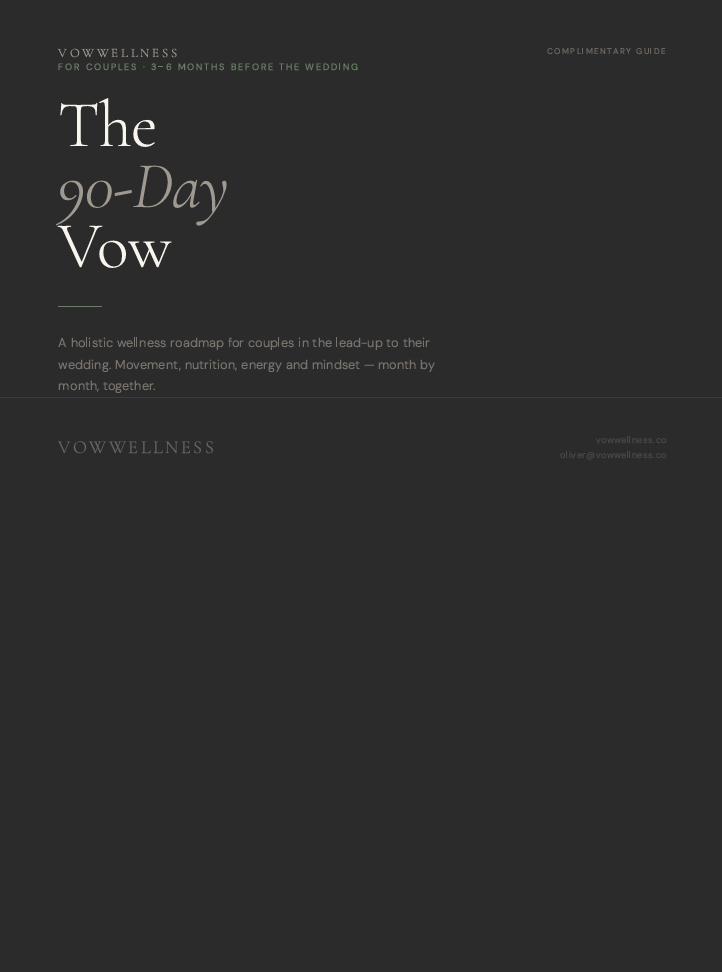
Our free guide, The 90-Day Vow, gives you a complete month-by-month framework for building the habits that matter most before your wedding structured specifically for couples, and designed to outlast the day itself.